

Lukas Meister
Senior Consultant
When Temporary Workarounds Become Structural Bottlenecks
One of our retail banking clients was facing this exact challenge. An advisory process for corporate clients — generating substantial revenue for the business — had been embedded into the existing architecture by extending systems that were originally designed for entirely different purposes. A trading system was expected to perform regulatory checks, a document generation tool assumed responsibility for core process logic, and the CRM system was used to document advisory activities it was never designed to support.
While management repeatedly acknowledged the need for a dedicated solution, its implementation was continuously postponed due to underestimated urgency and reluctance to address the required investment.
Tangible Consequences
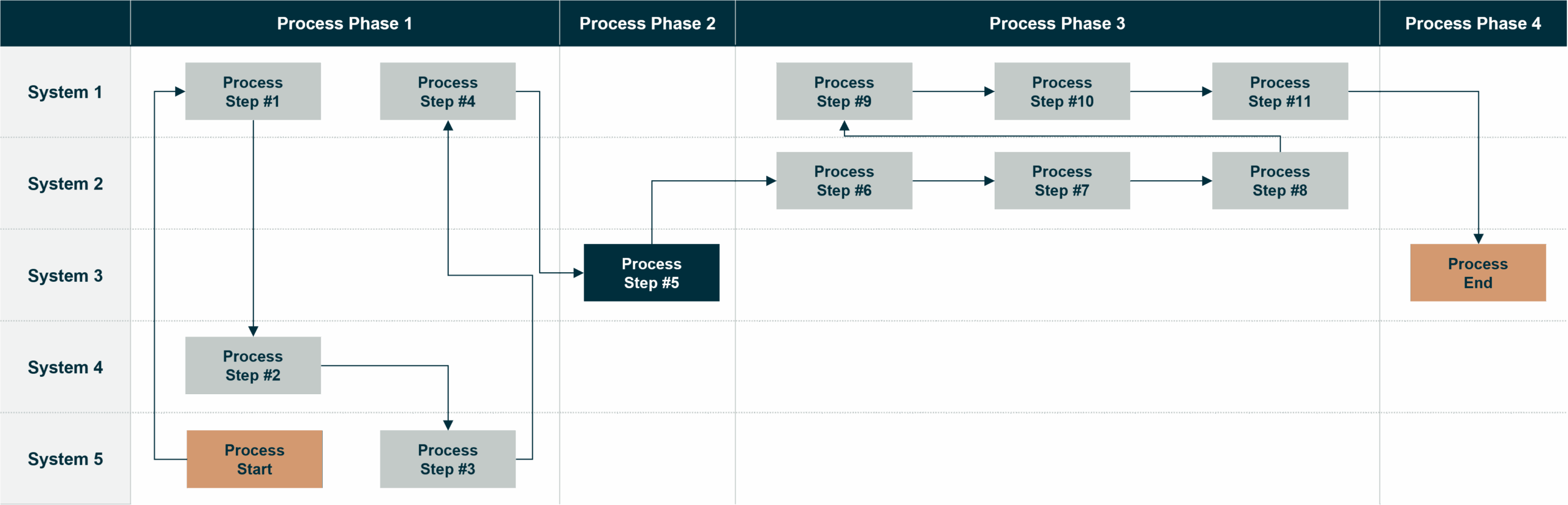
Over time, this interim setup evolved into a highly complex and fragmented process landscape spanning more than a dozen systems. Advisors were forced to manually copy and paste data, repeat steps across applications, and increasingly lost clarity over which actions were required and in what sequence. As a result, regulatory risks increased and advisory services were offered less frequently — ultimately leading to a tangible loss in revenue.
Operational Pain Point Highlights
- Excessive process complexity
- The business process had grown so complex that users often lacked clarity on required steps and their correct sequence, occasionally failing to complete entire process flows
- Fragmented user journey
- Users were required to navigate across more than a dozen systems, frequently switching back and forth between applications to complete a single advisory process. This constant switching not only disrupted the end-to-end user journey but also increased cognitive load and reduced overall process clarity, ultimately leading to lower adoption and a higher likelihood of execution errors, as observed in studies on digital workplace efficiency (Murty et al., 2022; Mark et al., 2008).
- Lack of data automation and integration
- Relevant data from surrounding systems was largely not integrated into the advisory process, forcing users to manually copy and paste information between systems multiple times
- Erosion of knowledge and expertise
- As fewer users actively offered the advisory service to clients, hands-on experience declined, leading to reduced knowledge transfer and diminishing expertise across the organization
- Increase in negative regulatory audit findings
- Limited transparency and process fragmentation resulted in a noticeable rise in errors, including manual data entry mistakes and the omission of mandatory process steps
- High maintenance effort across multiple systems
- With core business logic distributed across several applications, even minor process changes required adaptations in multiple systems, causing additional effort, delays, and increased costs
The solution
To address the challenges caused by a fragmented and increasingly complex legacy setup, the client engaged Senacor to analyze the current state, conceptualize viable solution options, and design a successor for the existing setup. The objective was not only to resolve immediate operational issues, but to establish a sustainable foundation for a core business process that had outgrown its interim implementation.
The approach taken in this engagement can serve as an effective blueprint for organizations facing similar challenges when modernizing legacy processes. By combining structured analysis, end-to-end process design, and architectural clarity, the transformation aimed to unlock additional revenue potential while improving cost efficiency and operational resilience.
The transformation was structured into three phases, each building upon the previous one to ensure a successful and implementable outcome.
Phase 1: Analysis
As a first step, the existing legacy process was analyzed in detail to establish a solid understanding of the current situation. The as-is process was documented end-to-end and structured into coherent process categories to improve transparency and comparability.
In parallel, the current system landscape was assessed, including all relevant applications and interfaces involved in the process. This analysis made it possible to identify the main operational pain points and map them to the specific process steps where they most frequently occurred.
Based on this foundation, potential target systems were identified, ranging from the introduction of an entirely new application to the repurposing or consolidation of existing systems to centrally host the core process logic. In addition, potential synergies with other business processes were examined, particularly where shared steps or reusable modules could be leveraged.
The analysis phase concluded with the definition of a high-level vision outlining key characteristics of an ideal future process and IT landscape. Rather than prescribing a detailed solution, this target picture focused on guiding principles such as improved user guidance, automated data integration, as few system switches as necessary, and enhanced end-to-end transparency.
Phase 2: Conceptualization
Building on the analytical insights, the conceptualization phase translated the high-level target picture into a concrete and actionable design.
From a process architecture perspective, the future business process was incrementally designed by defining an ideal end-to-end flow, decomposing it into logical segments, and systematically comparing it with the existing process. This made it possible to assess which steps could be kept, needed to be added, redesigned, or removed entirely.
In parallel, the system architecture was developed by identifying all surrounding systems, clarifying their primary business purpose, and defining the data and interfaces they would provide to the target solution. Just as importantly, clear boundaries were established to determine which responsibilities and tasks would explicitly remain out of scope for each system.
A key success factor throughout this phase was continuous stakeholder involvement. The evolving target picture for both process and architecture was regularly discussed and validated with relevant business units, end users, product owners, legal and compliance representatives, and internal sponsors. This ensured alignment across organizational boundaries and helped refine the solution based on practical feedback.
As part of the conceptualization, potential target system options were evaluated in close collaboration with product owners, enterprise architects, and the affected business areas. Each option was assessed regarding feasibility, complexity, risks, and overall effort, resulting in the selection of a dedicated target system best suited to support the redesigned process. In this case, a dedicated application integrated into the existing framework architecture provided the necessary structural separation to sustainably resolve the issues at hand.
Subsequently, detailed business requirements were defined for both the target system and the surrounding applications. These requirements formed the basis for effort estimations covering internal and external implementation activities across the entire project.
Finally, a budget and development plan was established. This included alignment with stakeholders on capacity constraints, timeline expectations, and budget limits, as well as the definition of a minimum viable product (MVP) and subsequent expansion stages. A high-level implementation roadmap was created to provide a clear timeline for delivering the new process application in a structured and phased manner.
Phase 3: Implementation
During the implementation phase, the conceptual target picture was translated into a concrete and operational solution. The phase began with the detailed specification of technical requirements to ensure alignment with the defined target architecture and to establish a stable and scalable foundation. In parallel, detailed UI/UX designs were created to support a clear and intuitive end-to-end user journey, refined through iterative feedback from end users.
Given the complexity of the existing system landscape and the high number of functional, technical, and regulatory dependencies, the project deliberately adopted an agile development approach. Incremental delivery allowed functionality and integration points to be validated early, reducing overall project risk and enabling required adjustments before issues propagated across the landscape. Continuous coordination with surrounding systems ensured seamless integration and effective dependency management throughout development.
Comprehensive testing followed, including functional, integration, and end-to-end scenarios. Business users were actively involved in acceptance testing to confirm that the solution met operational and regulatory requirements. The phase concluded with structured rollout activities, targeted user training, and the go-live of the minimum viable product (MVP), providing a solid foundation for future expansion stages.
The Results
Based on a fragmented legacy setup with high manual effort and operational risk, the transformation defined clear objectives around system consolidation, process guidance, automation, and long-term architectural sustainability. The following results summarize how these goals were achieved through targeted process and architecture decisions.
- Significantly reduced system fragmentation
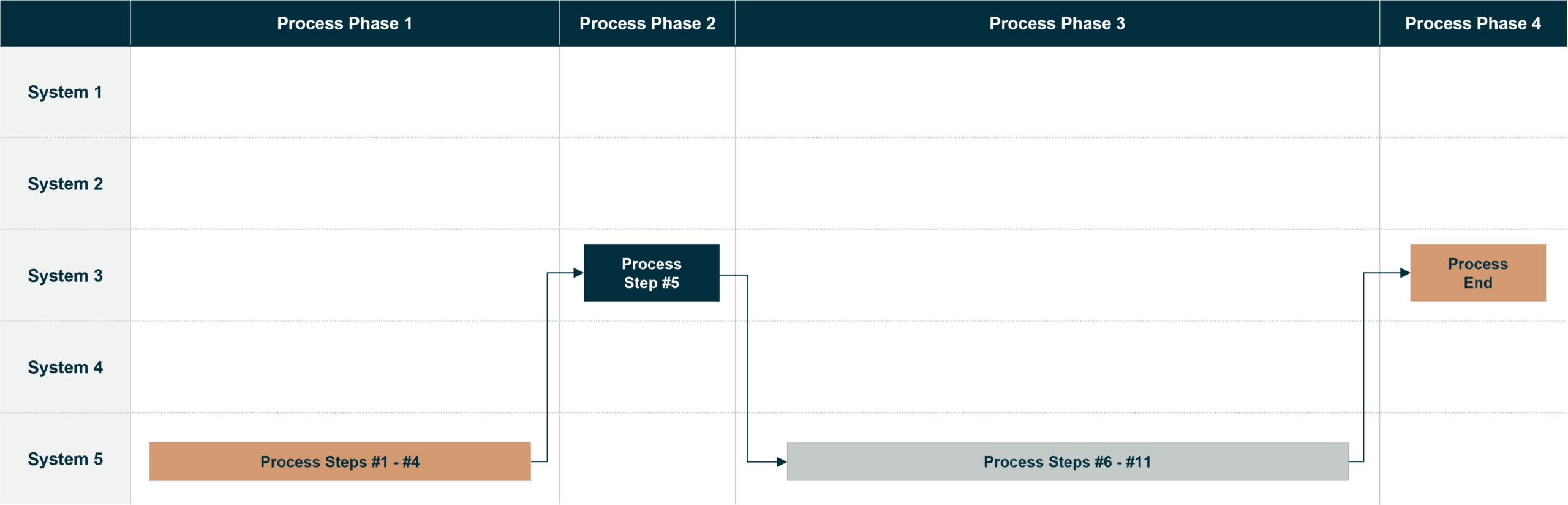
- Advisors interact with only two central systems – substantially reducing system switches and manual coordination effort
- Efficient, end-to-end process guidance for advisors
- Modular process design, guided workflows, and intermediate data storage enable a structured, yet flexible advisory process tailored to daily operational needs. A setup which reduces the likelihood of process-related errors while improving overall operational efficiency, as supported by recent research (Adepoju et al., 2022).
- Automated data flows and regulatory checks
- Relevant information is transferred seamlessly across systems, while regulatory validations are executed automatically, reducing manual effort and operational risk
- Reduced documentation effort through AI-based conversation summarization
- An AI-based service automatically generates structured summaries and metadata from recorded client conversations, significantly reducing manual documentation effort while improving consistency, completeness, and overall documentation quality
- Future-proof and well-integrated architecture
- Functional and technical extensions are already considered within the target architecture, enabling the solution to evolve over time while seamlessly integrating into the existing IT landscape and deliberately reusing established components rather than introducing siloed functionality
- Sustainable cost reduction through system consolidation
- By eliminating redundant process steps and reducing the number of systems involved, long-term maintenance and change costs are lowered. Core process logic is consolidated within a single application, allowing future enhancements to be implemented centrally rather than across multiple systems.
Before
After
From Legacy Constraints to Sustainable Solutions with Senacor
Modernizing legacy processes is rarely about replacing individual systems. Increasing regulatory pressure, growing time-to-market expectations, and a rising dependency on tightly coupled legacy architectures expose the limits of temporary solutions that were never designed to scale. As core processes evolve beyond the structures they were originally embedded in, organizations are forced to disentangle years of interim fixes, clarify end-to-end responsibilities, and realign their business processes with a future-proof architecture.
With extensive experience in large-scale transformation initiatives, Senacor supports clients across industries in making their legacy landscapes fit for modern business and regulatory requirements. By combining deep process understanding, architectural expertise, and a strong focus on usability and implementation feasibility, Senacor helps organizations move from fragmented interim setups to sustainable, scalable solutions. This approach enables clients not only to stabilize existing operations, but also to improve agility, reduce risk, and unlock long-term efficiency and growth potential on a solid foundation.
Sources
- Martini, J. Bosch and M. Chaudron, „Architecture Technical Debt: Understanding Causes and a Qualitative Model,“ 2014 40th EUROMICRO Conference on Software Engineering and Advanced Applications, Verona, Italy, 2014, pp. 85-92, doi: 10.1109/SEAA.2014.65.
- Tom, Edith, Aybüke Aurum and Richard T. Vidgen. “An exploration of technical debt.” Syst. Softw. 86 (2013): 1498-1516.
- Codabux and B. Williams, „Managing technical debt: An industrial case study,“ 2013 4th International Workshop on Managing Technical Debt (MTD), San Francisco, CA, USA, 2013, pp. 8-15, doi: 10.1109/MTD.2013.6608672.
- Murty, R. N., Dadlani, S., & Das, R. B. (2022, August 29). How Much Time and Energy Do We Waste Toggling Between Applications? Harvard Business Review. https://hbr.org/2022/08/how-much-time-and-energy-do-we-waste-toggling-between-applications
- Mark, Gloria & Gudith, Daniela & Klocke, Ulrich. (2008). The cost of interrupted work: More speed and stress. Conference on Human Factors in Computing Systems – Proceedings. 107-110. 10.1145/1357054.1357072.
- Adebusayo, Hassanat & Adepoju, Adebusayo & Austin, Blessing & Eweje, Adeoluwa & Collins, Anuoluwapo. (2022). Framework for Automating Multi-Team Workflows to Maximize Operational Efficiency and Minimize Redundant Data Handling. 5. 663-679.