

Dr. Daniel Nohr
Managing Consultant

Katerina Tatidis
Consultant
The European Central Bank is currently driving forward the development of the digital euro. For some, it represents the beginning of a cashless surveillance society. For others, it is the long-awaited European alternative to PayPal and other non-European payment providers. However, among countless debates and headlines, fact and fiction often become blurred. It is therefore time to take a realistic look at some of the most common myths surrounding the digital euro.
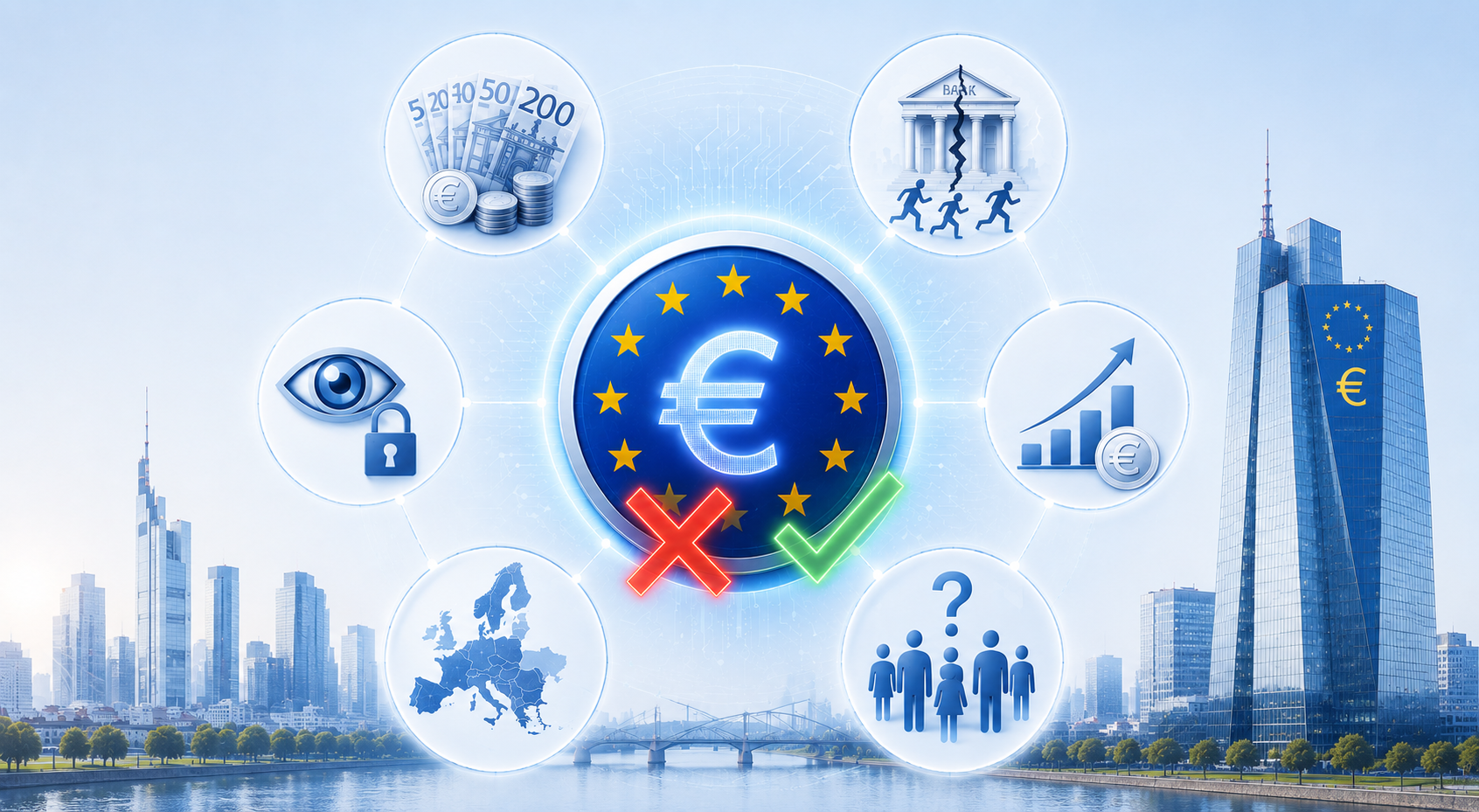
Myth 1: “The digital euro will replace cash”
The concern behind this myth is simple: once the digital euro is introduced, physical cash will slowly disappear from everyday life. However, the declining use of cash is already happening today, primarily because consumers prefer cards and digital wallets for convenience. While cash still plays an important role in some EU-countries, fully digital payment habits have already become common in others. On the contrary, the European Central Bank explicitly positions the digital euro as a complement to cash, not a replacement. Cash would remain legal tender. The digital euro would therefore represent an additional digital extension of the existing monetary system, alongside cash and other existing digital means of payment rather than instead of it.
Myth 2: “The digital euro will immediately trigger bank runs”
A bank run describes a situation in which many customers try to withdraw their deposits from a bank at the same time, usually triggered by a loss of confidence. A recent example was the collapse of Silicon Valley Bank in 2023 [1]. Thus, if citizens could hold money directly in central bank money, they might shift deposits away from commercial banks during times of uncertainty. In theory, a digital bank run could happen even faster than traditional cash withdrawals. This is why central banks and regulators are addressing the issue. Current digital euro concepts already include several safeguards. These include holding limits and the absence of attractive interest rates, to prevent potential bank runs.
Myth 3: “The digital euro can be used as an investment”
That’s not true. The digital euro is intended as a payment instrument, not as an investment product or savings account at the central bank. It would be pegged 1:1 to the euro and therefore hold the same value as money held in a commercial bank account. As a result, the digital euro would not be a standalone speculative asset, since it would be subject to the same value and exchange-rate dynamics as the regular euro itself. Therefore, there are no exchange rate gains and there is no investment function. The digital euro is also not a speculative crypto asset and certainly not “Bitcoin issued by the ECB”. While Bitcoin was partly developed to bypass traditional financial intermediaries such as banks, the digital euro would remain integrated into the existing financial system and operate in cooperation with banks and payment service providers.
Myth 4: “Nobody needs the digital euro”
We already have cards, apps and digital wallets. So, why would we need a digital euro? This question comes up frequently. Indeed, there is no shortage of fast and convenient payment methods today. The actual added value of the digital euro lies elsewhere, namely in resilience, independence and European sovereignty. Europe’s payment ecosystem currently depends on a small number of international providers. If one of these systems were to fail due to technical issues or geopolitical tensions, critical dependencies could emerge. While European initiatives such as Wero are already creating alternatives for Europe, the digital euro would go one step further. It would create a pan-European payment infrastructure across the entire euro area. The vision is a solution that works seamlessly for point-of-sale, online payments and peer to peer transactions alike, accessible to everyone across Europe. Therefore, the digital euro is less about creating another payment app and more about establishing a common European digital payment foundation.
Myth 5: “Only Europeans will be able to use the digital euro”
The digital euro is a European project, so it looks like it will only be available to European citizens. However, the planning discussions suggest otherwise. According to the current status, the digital euro would not necessarily be limited to residents of the euro area. Tourists and business visitors from outside Europe could also potentially use it for payments during their stay in the eurozone. In addition, current discussions indicate that under specific conditions, individuals and businesses outside the euro area could also gain access to the digital euro. Such access would depend for example on contracts and agreements between the European Union and central banks. In practice, however, access for non-eurozone users would most likely be enabled through existing payment providers or temporary usage models. Opening a permanent euro account purely for tourism purposes appears rather unlikely. The digital euro would therefore remain a European solution, but not necessarily one restricted exclusively to European citizens.
Myth 6: “The ECB will be able to see every payment”
Many people fear that the ECB could monitor every payment made with the digital euro. Yet, the digital euro sits precisely at the intersection of two competing priorities: protecting user privacy and complying with regulatory requirements. The challenge is therefore to enable digital payments without exposing personal transaction data. For this reason, the ECB has emphasized privacy and data protection as core design principles of the digital euro. Current concepts include a potential offline payment functionality, which could provide a level of privacy similar to cash, and encrypted payment information. Ironically, many private technology companies already have far more insight and interest into consumer payment behaviour today than the ECB would have under a digital euro framework. Existing providers usually operate within data-driven ecosystems where transaction data is not only used for processing, but also for analytics and in some cases for monetisation of personal insights. By contrast, the design principles of the digital euro explicitly aim to minimise data exposure and payment participants of transactions could not be directly identified. Furthermore, restrictions on how individuals spend their money are also considered highly unlikely.
Conclusion: The digital euro is no longer a distant future topic
While the pilot of the digital euro is planned for the upcoming year, the project is currently in its technical readiness phase. For more information on this phase click here.
Key foundations from technical architecture to regulatory frameworks and operational models are already being developed. As a result, the digital euro is no longer a theoretical future concept. A fact-based understanding of the associated opportunities, risks and misconceptions is becoming increasingly important. For banks and financial service providers, the key question is therefore no longer if digital euro development matters but rather: How should systems and processes be prepared for digital euro scenarios? If you would like to get in touch, please visit our website: Digitaler Euro | Senacor Technologies AG
[1]How does a bank collapse in 48 hours? A timeline of the SVB fall | CNN Business
Transparency note: The images used in this article are AI generated.